General, Lifted Truck Information

How Much Does Towing Lower My Fuel Economy?

Your truck gets a solid 18 mpg cruising down the highway… until you hook up the camper. Suddenly, you’re seeing 10-12 mpg and watching the fuel gauge drop like a rock.

Here’s the straight answer: towing typically drops your MPG anywhere from 20% to 50%, depending on what you’re hauling, how fast you’re going, the terrain, and how you drive. The two biggest culprits are weight and aerodynamic drag. Your engine works harder to move all that extra mass, while pushing a big trailer through the air creates massive resistance.

We’ll break down the MPG loss you can expect, explain why towing kills fuel economy, and share practical ways to reduce the hit and plan your fuel costs better.

Why Towing Lowers Your Fuel Economy
towing impact on fuel economy

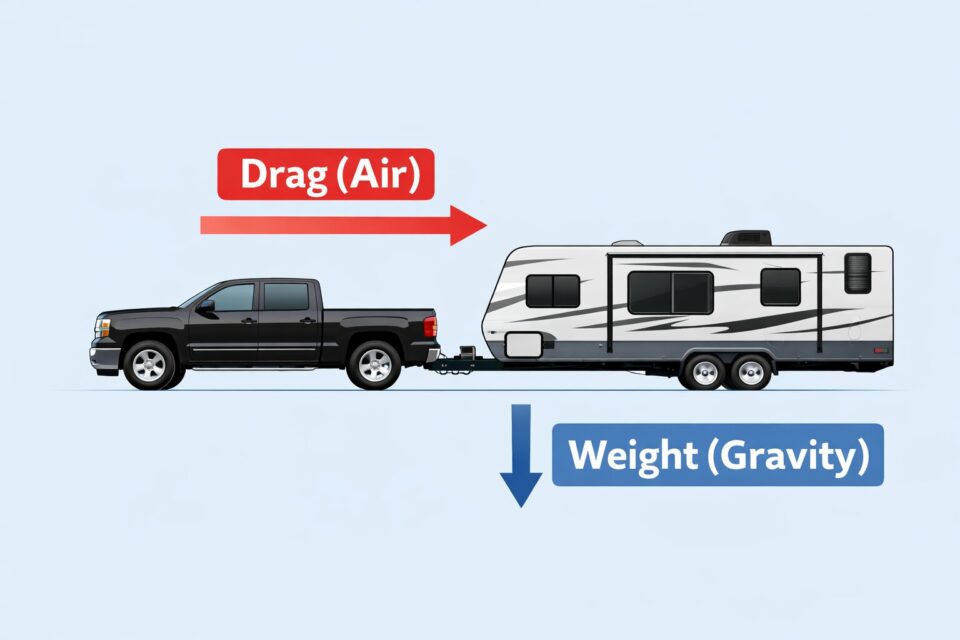
Does towing consume more fuel? For sure it does, and there are two main reasons why.

First, extra weight forces your engine to burn more fuel when accelerating and climbing hills. Every 100 lbs typically reduces fuel economy by roughly 1-2%. A 5,000-lb camper plus gear adds up fast.

Second, aerodynamic drag creates a bigger “wall” to push through the air. The boxier and taller your trailer, the worse this gets. Air resistance increases exponentially with speed, so at 60-70 mph with a tall trailer, your engine works overtime just to maintain speed. This is why highway MPG often takes the biggest dive when towing.

Your vehicle’s factory MPG ratings assume light cargo and no trailer, so towing is always “off-spec” compared to that window sticker.
towing tax infographic

How Much MPG Drop to Expect When Towing

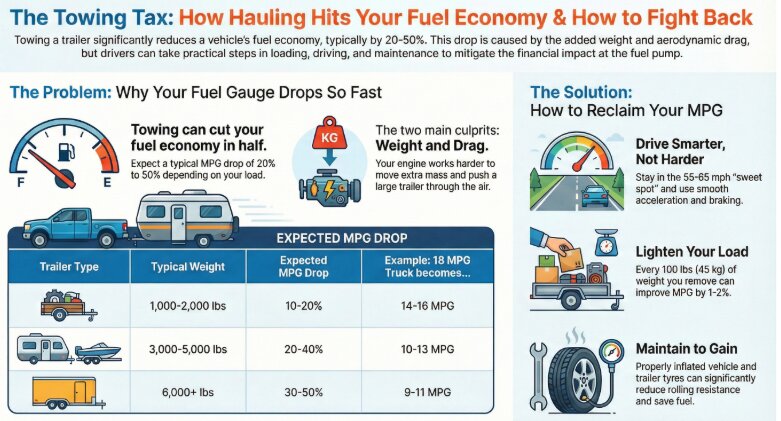
Let’s talk real numbers. The exact MPG drop varies, but here are typical ranges:

Light utility trailer or small cargo (1,000-2,000 lbs, low profile): Maybe 10-20% MPG drop at moderate speeds. A truck getting 18 mpg might see 14-16 mpg.

Mid-size camper or boat (3,000-5,000 lbs, more frontal area): Expect 20-40% drop. That 18-mpg truck falls to around 10-13 mpg.

Heavy camper or enclosed trailer (6,000+ lbs, big frontal area): Commonly 30-50% MPG drop, sometimes more at high speeds or in hills. Your 18 mpg truck might deliver only 9-11 mpg.

Put another way: a 600-mile trip needs 33 gallons at 18 mpg, but 55-60 gallons at 10 mpg. That’s the reality of towing.

Smaller engines and lighter-duty vehicles often see bigger percentage drops than heavy-duty trucks designed for towing.

Factors That Make Your MPG Drop More (or Less)

Not all towing hits fuel economy equally. Here’s what makes the difference:

Total Weight (Vehicle + Trailer + Cargo)

Heavier means more fuel per mile. Don’t forget tongue weight and gear in your truck bed – it all counts against you.

Speed

Above 50-60 mph, aerodynamic drag ramps up fast. The jump from 60 mph to 75 mph dramatically worsens towing MPG. Does tow haul use more gas at high speeds? The mode itself helps manage shifts, but wind resistance is the real killer.

Trailer Shape (Aerodynamics)

Tall, boxy campers create way more drag than low-profile boats or flatbeds. Roof racks and bikes on top add noticeable drag too. How much does weight affect gas mileage compared to aerodynamics? At highway speeds, aerodynamics often matters more.

Terrain & Traffic

Hills force your engine to work much harder. Stop-and-go traffic means repeatedly burning fuel to accelerate all that weight from stops. Long, flat stretches at steady speeds are your friend.

Engine Type & Size

Diesels typically get better fuel economy under load and lose a smaller percentage when towing. Bigger, torquier engines working comfortably beat small engines maxed out.

Drivetrain & Gearing

4WD versus 2WD, axle ratios, and transmission behavior all affect MPG. Does tow mode use more gas? It changes shift patterns to protect your transmission, slightly lower peak MPG, but prevents gear hunting that wastes more fuel.

Trailer & Load Setup: Small Changes, Real MPG Gains

Small adjustments to your trailer and loading can claw back meaningful fuel economy.

Choose lighter trailers: Aluminium weighs less than steel. Minimalist builds save several hundred pounds. Every 100 lbs saved equals roughly 1-2% better MPG.

Keep it streamlined: Avoid unnecessary height. Remove roof racks, cargo boxes, and bike racks when not using them, even empty, as they create drag.

Load placement matters: Proper tongue weight prevents sway that forces corrections and wastes fuel. Secure items so nothing shifts during transit.

Leave what you don’t need: Unused gear, extra water, tools—it adds up fast. Every 100 lbs left behind buys back about 1-2% fuel economy.

Driving Habits That Help Fuel Economy While Towing

How you drive makes a real difference in fuel costs.

Keep speeds reasonable: The 55-65 mph range is often the sweet spot for towing MPG. Above 75 mph, wind resistance kills economy. Use cruise control on flat highways, but avoid it on steep hills.

Accelerate and brake smoothly: Gentle throttle and anticipating slowdowns prevent wasting fuel on repeated hard acceleration. Avoid “sprint then coast” driving.

Plan your route: Routes with less stop-and-go, fewer steep climbs, and steady speeds save fuel. Sometimes a longer route on flat terrain beats a shorter hilly one.

Avoid unnecessary idling: Shut down during longer stops. Modern engines don’t need a warm-up, and the fuel savings add up.

Use tow mode smartly: It protects your transmission and prevents gear hunting. Slightly lower peak MPG beats excessive shifting that wastes more fuel long-term.

Vehicle & Trailer Maintenance That Protects MPG

Basic maintenance pays off in better fuel economy and fewer breakdowns.

Tire pressure: Underinflated tires (vehicle or trailer) increase rolling resistance. Being 20% low can increase fuel use and overheat tires. Check pressure before every trip, and if you’re running a lifted truck, proper tire pressure becomes even more critical for towing safely.

Wheel bearings & brakes: Dragging trailer brakes or dry bearings creates extra resistance. Properly greased bearings and adjusted brakes let your trailer roll freely.

Alignment: Misalignment causes tire scrubbing and higher rolling resistance. If your vehicle pulls to one side, get it checked.

Engine health: Clean air filter, correct oil grade, and well-maintained transmission and cooling system all help efficiency under heavy loads.

Bottom line: if it makes your rig harder to roll, it’s costing you fuel. Maintenance reclaims MPG and prevents breakdowns.

Estimating Fuel Cost When Towing

Planning ahead helps you budget for fuel and schedule stops.

Simple estimation method:

  1. Start with your vehicle’s real-world highway MPG (not window sticker)
  2. Estimate towing MPG drop: light trailer ~20%, medium ~30-35%, heavy ~40-50%
  3. Calculate fuel needed: trip distance ÷ towing MPG = gallons
  4. Multiply by the local fuel price for the trip cost

Example: Your truck gets 18 mpg normally. Towing a heavy camper drops it 40% to about 11 mpg. A 600-mile trip needs roughly 55 gallons. At $3.50/gallon, that’s $192 versus $115 without towing, an extra $77.

Keep notes on actual towing MPG after trips. Real-world data beats estimates and helps you plan better next time.

The Bottom Line: Towing Costs More, But You’re Not Helpless

Look, let’s be real, towing is going to hit your wallet at the pump. That 20-50% MPG drop isn’t going away, and there’s no magic trick to make a 6,000-lb camper disappear into thin air. Weight is weight, drag is drag, and physics doesn’t negotiate.

But you know now that every 100 lbs you ditch saves you 1-2% on fuel. You know that backing off from 75 mph to 60 mph can make a real difference. You know that underinflated tires and dragging brakes are stealing money from your pocket on every mile.

So before your next trip, take 20 minutes. Check your tire pressure. Toss out the gear you’re not using. Plan a route that doesn’t involve climbing every mountain between here and there.

Ready to make sure your truck is up to the challenge?

Check out our lift shop for towing-ready modifications, or browse our full inventory of lifted trucks that can handle whatever you need to haul.
Related Articles

Best Truck Lift Kits for All Your Off-Road Needs (2026 Picks)May 14, 2026

Best Truck Lift Kits for All Your Off-Road Needs (2026 Picks)

You're looking at your stock truck and thinking it needs more clearance, bigger tires, or just a meaner stance. A lift kit will get you there, but with dozens of…

Read more
When Should I Use 2Hi, 4Lo, and 4Hi?May 14, 2026

When Should I Use 2Hi, 4Lo, and 4Hi?

You're staring at your 4WD selector showing 2H, 4H, and 4L, and the road ahead is getting sketchy. Which one do you actually use? Most 4WD trucks and SUVs give…

Read more
How Much is Ford F-150 Towing Capacity?May 14, 2026

How Much is Ford F-150 Towing Capacity?

You're shopping for a camper or boat and need to know: what is the towing capacity of a Ford F-150? The Ford F-150 towing capacity ranges from 5,000 lbs to…

Read more
How to Get Precision Steering in Your Lifted TruckJune 16, 2025

How to Get Precision Steering in Your Lifted Truck

If you've ever felt your lifted rig drifting, wandering, or not steering with confidence, you're far from alone. Many truck owners ask questions like “Why is my truck steering so…

Read more
Why Does My Lifted Truck Squeak?June 16, 2025

Why Does My Lifted Truck Squeak?

If you’ve ever rolled your window down and winced at the sharp squeak echoing from your lifted truck, you’re not alone. You might be wondering, why does my lifted truck…

Read more
Truck Lift and Tire Pressure: The Ultimate GuideJune 2, 2025

Truck Lift and Tire Pressure: The Ultimate Guide

If you’ve ever wondered about the recommended tire pressure for pickup trucks, you’ve undoubtedly discovered that this is a fairly complex topic. To be clear, tire pressure is absolutely crucial…

Read more
Skid Plates Explained: Cost, Benefits & Whether You Actually Need OneJune 2, 2025

Skid Plates Explained: Cost, Benefits & Whether You Actually Need One

Skid plates are a necessary, even essential element to protect your truck when you go off-road driving. These fixtures are important because they help to shield sensitive vehicle components from…

Read more
Why Does My Truck Feel Like It’s Bouncing?April 22, 2025

Why Does My Truck Feel Like It’s Bouncing?

Many truck owners experience an unsettling sensation while driving - that unmistakable bouncing feeling that makes every journey a challenge. This bouncing doesn't just create an unpleasant ride; your safety…

Read more
Why Does a Lifted Truck Shake at High Speeds?April 22, 2025

Why Does a Lifted Truck Shake at High Speeds?

So you've finally installed that lift kit you've had your eyes on for months. Your truck looks amazing sitting high off the ground with those aggressive new tires. But then…

Read more
Can a Lifted Truck Be a Daily Driver?March 21, 2025

Can a Lifted Truck Be a Daily Driver?

You have probably seen a towering lifted truck thundering down the highway before and thought to yourself, "Sure, it looks great… but can a lifted truck be a daily driver?"…

Read more
What Is the Purpose of a Lifted Truck?March 21, 2025

What Is the Purpose of a Lifted Truck?

Trucks come in all shapes and sizes. After all, that's what makes them such a fun ride. But nothing catches the eye quite like a lifted truck. Built for cruising…

Read more
Beadlock Wheels: What Are They? Pros and ConsFebruary 21, 2025

Beadlock Wheels: What Are They? Pros and Cons

Among the most talked-about wheel technologies in the off-road community are beadlock wheels, and for good reason. While not essential for all off-road driving, they excel at handling very low…

Read more
How Much Does it Cost to Get a Truck Lifted?January 29, 2025

How Much Does it Cost to Get a Truck Lifted?

The decision to lift your truck opens up a world of possibilities. Each year, thousands of truck owners upgrade their vehicles from stock to stunning with a professional lift. With…

Read more
Leveling Kit vs. Lift Kit: What to Choose?January 29, 2025

Leveling Kit vs. Lift Kit: What to Choose?

You've seen them on the road – those head-turning trucks that command attention with their towering presence. If that stock truck height from the factory doesn't cut it for you…

Read more
Ford Sync Bluetooth Audio Not Working (Tips & Tricks)January 12, 2025

Ford Sync Bluetooth Audio Not Working (Tips & Tricks)

Having trouble connecting your phone to your Ford vehicle? Is your music not playing like it's supposed to? You're certainly not alone. There's no denying it would be fantastic if…

Read more
Body Lift vs Suspension Lift: Lifted Trucks GuideJanuary 12, 2025

Body Lift vs Suspension Lift: Lifted Trucks Guide

Choosing the Right Lift for Your Truck or SUV Are you thinking about installing a lift kit on your current vehicle, or buying your next ride with a lift pre-installed? If…

Read more
Ohio Truck Lift Laws | Guide for Lift KitsJanuary 12, 2025

Ohio Truck Lift Laws | Guide for Lift Kits

Maximum Height on Vehicles in Ohio Ohio is one of the most favorable states when it comes to upgrading a vehicle with custom suspension. That's because there are few laws in…

Read more
Smoke Bombs And SilveradosJuly 6, 2024

Smoke Bombs And Silverados

In the realm of pickup trucks, few vehicles command as much attention and admiration as the Chevrolet Silverado. Known for its rugged reliability and formidable performance, the Silverado has carved…

Read more
NC Window Tint Law for Trucks | North Carolina Window TintingFebruary 25, 2023

NC Window Tint Law for Trucks | North Carolina Window Tinting

Tint Laws in North Carolina Like many other states in America, North Carolina has some pretty strict regulations in place when it comes to window tint on a vehicle. This…

Read more
Uconnect Hard Reset Ram | Steps to Reset UconnectFebruary 25, 2023

Uconnect Hard Reset Ram | Steps to Reset Uconnect

While there's no doubt that infotainment systems have improved our experiences behind the wheel over the last decade or so, in a lot of ways there is still plenty of…

Read more
Uconnect Hard Reset Procedure | How to Reset Your UconnectFebruary 25, 2023

Uconnect Hard Reset Procedure | How to Reset Your Uconnect

While infotainment systems can be a massive benefit to today's drivers, running into problems with this technology is all too common. Thankfully, there are a few easy things you can…

Read more
Florida Lift Laws | Lift Your Truck or SUVFebruary 21, 2023

Florida Lift Laws | Lift Your Truck or SUV

Florida Vehicle Regulations - Maximum Height Across the United States, there are laws put in place that restrict vehicle customization in the name of safety. Depending on where you live,…

Read more
How High Can You Legally Lift Your Truck in Florida? | Lift Kit GuideFebruary 21, 2023

How High Can You Legally Lift Your Truck in Florida? | Lift Kit Guide

How High Can You Lift Your Vehicle in Florida? If you have plans to raise the height of your truck or SUV in the state of Florida, we have some…

Read more
North Carolina Lift Laws | Lifted TrucksFebruary 4, 2023

North Carolina Lift Laws | Lifted Trucks

Height Restrictions on Lift Kits in North Carolina If you're a fan of lifted trucks and you live in North Carolina, you're in luck. That's because, according to liftlaws.com, North…

Read more

Two Brothers with a Dream

Nick and Alex Bulanda

Founders of Ultimate Rides

Ultimate Rides consists of two brothers who have been buying and selling custom vehicles for over ten years. Selling lifted trucks by day and writing these awesome reviews by night! They started their Ultimate Rides journey with a third brother Jake, who was a big part of building the business they have today. In 2016 Jake passed away and losing their brother was the hardest thing they ever had to deal with. Even though they had a tragic loss they plan to continue to set a new trend for the auto industry, keeping customers number one. Pushing the envelope on the lifted truck market, these guys love researching and learning about everything in the auto industry!